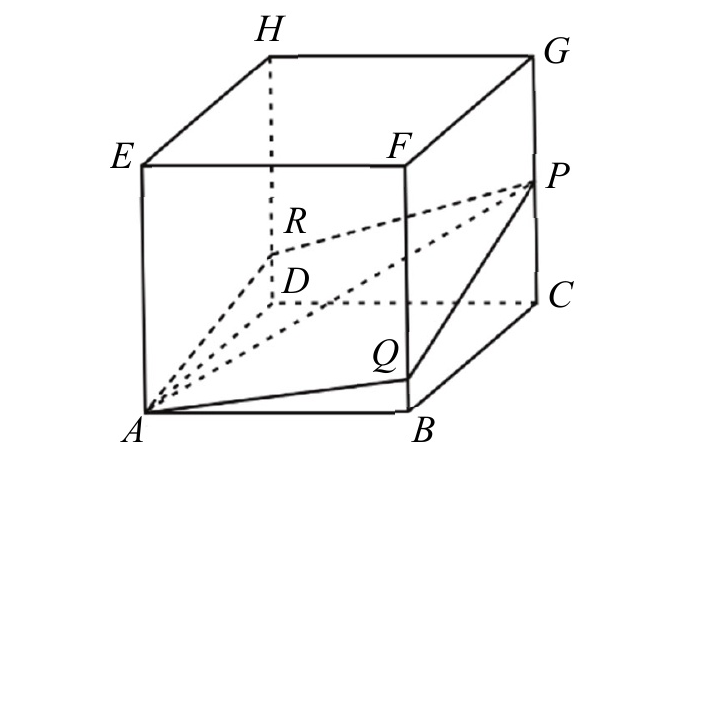
$(1)$ 由題意給定坐標系:$D(0,0,0)$、$A(1,0,0)$、$C(0,1,0)$、$H(0,0,1)$。
因為 $ABCD-EFGH$ 為邊長 $1$ 的正立方體,所以各頂點坐標為:
$B(1,1,0)$、$E(1,0,1)$、$F(1,1,1)$、$G(0,1,1)$。
因為點 $P$ 為稜邊 $\overline{CG}$ 的中點,且 $C(0,1,0)$、$G(0,1,1)$,
所以 $P$ 的坐標為 $(0, 1, \frac{1}{2})$。
$(2)$ 因為點 $Q$ 在稜邊 $\overline{BF}$ 上且 $\overline{BQ} = t$,而 $B(1,1,0)$、$F(1,1,1)$,
所以 $Q = (1, 1, t)$。
因為點 $R$ 在稜邊 $\overline{DH}$ 上,設 $R = (0, 0, s)$。
在平行四邊形 $AQPR$ 中,$\overset{\large\rightharpoonup}{AQ} + \overset{\large\rightharpoonup}{AR} = \overset{\large\rightharpoonup}{AP}$。
因為 $\overset{\large\rightharpoonup}{AQ} = (1-1, 1-0, t-0) = (0, 1, t)$,
$\overset{\large\rightharpoonup}{AR} = (0-1, 0-0, s-0) = (-1, 0, s)$,
$\overset{\large\rightharpoonup}{AP} = (0-1, 1-0, \frac{1}{2}-0) = (-1, 1, \frac{1}{2})$,
所以 $(-1, 1, s+t) = (-1, 1, \frac{1}{2})$,得 $s + t = \frac{1}{2}$,即 $s = \frac{1}{2} - t$。
因此 $\overset{\large\rightharpoonup}{AR} = (-1, 0, \frac{1}{2}-t)$。
$(3)$ 四角錐 $G-AQPR$ 的體積 $V$ 等於以 $\overset{\large\rightharpoonup}{AQ}$、$\overset{\large\rightharpoonup}{AR}$、$\overset{\large\rightharpoonup}{AG}$ 為稜的平行六面體體積的 $\frac{1}{3}$。
先計算 $\overset{\large\rightharpoonup}{AQ} \times \overset{\large\rightharpoonup}{AR}$:
因為 $\overset{\large\rightharpoonup}{AQ} = (0, 1, t)$,$\overset{\large\rightharpoonup}{AR} = (-1, 0, \frac{1}{2}-t)$,
所以 $$\begin{aligned}
\overset{\large\rightharpoonup}{AQ} \times \overset{\large\rightharpoonup}{AR}
&= \bigl(1\cdot(\tfrac{1}{2}-t)-t\cdot0,\ t\cdot(-1)-0\cdot(\tfrac{1}{2}-t),\ 0\cdot0-1\cdot(-1)\bigr) \\[4pt]
&= \bigl(\tfrac{1}{2}-t,\ -t,\ 1\bigr)
\end{aligned}$$。
因為 $\overset{\large\rightharpoonup}{AG} = (0-1, 1-0, 1-0) = (-1, 1, 1)$,
所以 $\overset{\large\rightharpoonup}{AG} \cdot (\overset{\large\rightharpoonup}{AQ} \times \overset{\large\rightharpoonup}{AR}) = (-1)(\frac{1}{2}-t) + (1)(-t) + (1)(1) = -\frac{1}{2} + t - t + 1 = \frac{1}{2}$。
因為三重積的絕對值為 $\frac{1}{2}$,且與 $t$ 無關,
所以 $V = \frac{1}{3} \times \frac{1}{2} = \frac{1}{6}$,為一定值。
$(4)$ 當 $t = \frac{1}{4}$ 時,$\overset{\large\rightharpoonup}{AQ} \times \overset{\large\rightharpoonup}{AR} = (\frac{1}{2}-\frac{1}{4}, -\frac{1}{4}, 1) = (\frac{1}{4}, -\frac{1}{4}, 1)$。
取法向量 $\mathbf{n} = (1, -1, 4)$(將外積結果乘以 $4$ 以簡化)。
因為平面 $AQPR$ 過點 $A(1,0,0)$,所以平面方程式為:
$1(x-1) + (-1)(y-0) + 4(z-0) = 0$,即 $x - y + 4z - 1 = 0$。
點 $G(0, 1, 1)$ 到此平面的距離為:
$$d = \dfrac{|0 - 1 + 4 \times 1 - 1|}{\sqrt{1^2 + (-1)^2 + 4^2}} = \dfrac{|2|}{\sqrt{18}} = \dfrac{2}{3\sqrt{2}} = \dfrac{\sqrt{2}}{3}$$
故 $
(1)\ (0, 1, \frac{1}{2})$;$
(2)\ (-1, 0, \frac{1}{2}-t)$;$
(3)\ \frac{1}{6}$;$
(4)\ \frac{\sqrt{2}}{3}$。