詳解
1寫出樣本空間
$a$ 的集合 $\{1,2,3,4,5,6\}$,$b$ 的集合 $\{1,2\}$,同時以 $a,b$ 之值組成方程組,樣本空間共 $6\times2=12$ 種,每種機率相等,可以表示為表格,如下表。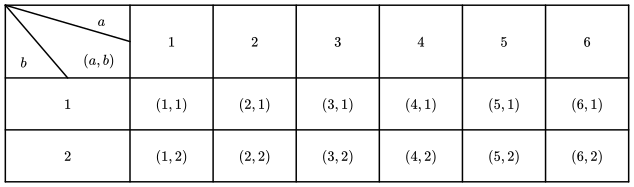
2逐項判斷
(1)X:$a=b$ 共有 $(1,1)$、$(2,2)$ 兩種,機率為 $\dfrac{2}{12}=\dfrac{1}{6}$。
(2)O:方程組無解 $\Leftrightarrow\dfrac{a}{1}=\dfrac{6}{b}\ne\dfrac{6}{1}\Leftrightarrow\begin{cases}ab=6\\a\ne6\\b\ne1\end{cases}$,解得 $(3,2)$ 一種,機率為 $\dfrac{1}{12}$。
(3)O:方程組無限多解 $\Leftrightarrow\dfrac{a}{1}=\dfrac{6}{b}=\dfrac{6}{1}\Leftrightarrow\begin{cases}a=6\\b=1\end{cases}$,解得 $(6,1)$ 一種;又由 (2) 可知無解的情況為一種,所以方程組恰有一解的情況有 $12-1-1=10$ 種,機率為 $\dfrac{10}{12}=\dfrac{5}{6}$。
(4)X:當 $b=2$,且方程組無解的情況為 $(3,2)$ 一種,其餘五種情況均為有解,機率為 $\dfrac{5}{12}$,不是 $\dfrac{1}{2}$。
(5)X:當 $b=2$,此時方程組為 $\begin{cases}ax+6y=6\\x+2y=1\end{cases}$,將 $y=\dfrac{1-x}{2}$ 代入 $ax+6y=6$ 得
$$ax+3-3x=6\ \Rightarrow\ (a-3)x=3$$
解得 $x=\dfrac{3}{a-3}$。因為方程組有解的情況為 $(1,2)$、$(2,2)$、$(4,2)$、$(5,2)$、$(6,2)$ 五種,其中使得 $x > 0$(也就是 $a > 3$)的有 $(4,2)$、$(5,2)$、$(6,2)$ 三種,所以機率為 $\dfrac{3}{5}$,不是 $\dfrac{2}{5}$。
故選 $(2)(3)$。